


-
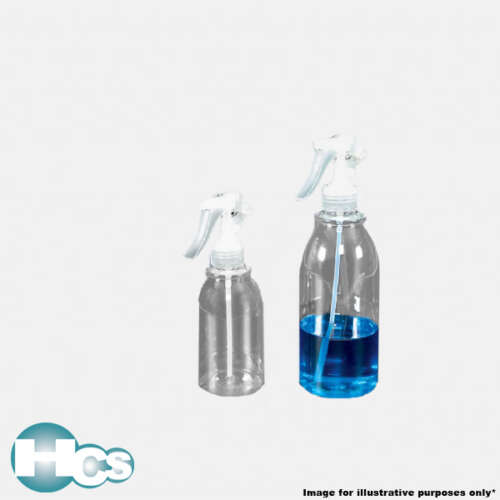 Manufactured from transparent PET with a spray head. All media contacting parts perfectly resist to most solvents and chemicals. Liquids can be finely vaporised with the pull of the hand pump trigger. Feature with a safety lock at the trigger which prevents accidental use.
 -
 Manufactured from HDPE. The spray bottle is equipped with a atomizer with adjustment jet. suitable for foodstuff.
 -
Manufactured from HDPE. The spray bottle is equipped with a atomizer with adjustment jet. suitable for foodstuff.
-
 Manufactured from polypropylene. Nominal capacity 30ml, Lid Ext. Ø57mm, Mouth Ext Ø52.1mm, Bottom Ext Ø45mm. The container with a leak-proof lid is autoclavable and is ideal for storage, collection and transportation of specimens.
 -
 Square Economy Stirrer Bars give a highly effective mixing over a wide range of conditions an offer outstanding value.
 -
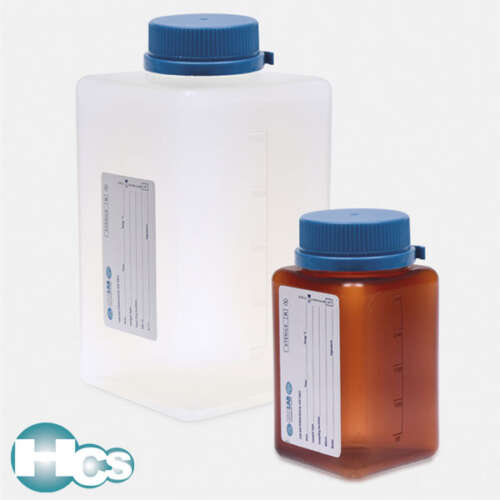 Manufactured from polypropylene (PP) for taking, transporting, and storing of water samples for microbiological analysis. Can be used for all analysis where a sterile sample is required. Bottles with sodium thiosulfate (20mg/lt - according to ISO/FIS 19458/2006 standard) are ideal for water analysis where chlorine may modify the composition of the sample. Manufactured at aseptically sterile production halls and then sent to gamma sterilization. Amber bottles preferably used with UV light sensitive samples. Square bottles offers easy handling and optimum space saving solutions. GL50 wide bottle neck provides easy filling and pouring. Embossed volume graduations on wall side offer better liquid level viewing.
 -
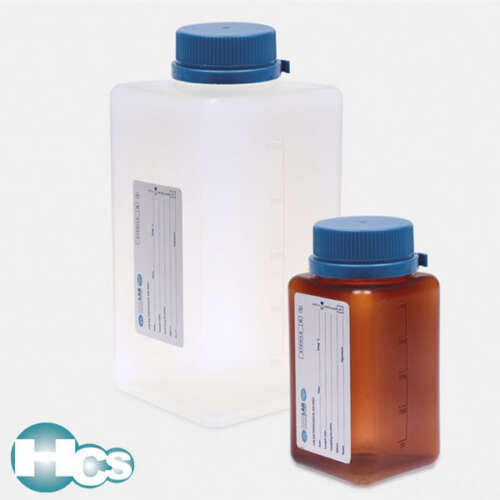 Manufactured from polypropylene for taking, transporting and storing of water samples for microbiological analysis. They can be used for all analysis where a sample is required. Bottles are manufactured at aseptically sterile production halls and then sent to gamma sterilization. Square bottle form offers easy handling and optimum spacing saving solutions. GL50 wide bottle neck provides easy filling and pouring. Cap with large ridges with increased grip featured with self lock and internal security ring. Cap inner design ensures hermetical and leak-proof closure. Caps are made of polyethylene. Embossed volume graduations on wall side offer better liquid level viewing. Clear bottles are manufactured from very clear P.P resulting with high transparency and for better view of the bottle content. Amber bottles are manufactured from special formulated P.P preventing UV light penetration into the flask yet still offering high transparency.
 -
 Manufactured from heavy alloy with different internal diameter for perfect fit to the necks of various volume erlenmeyers and flasks. Can fit nearly around the neck of erlenmeyers and other flasks preventing falling over or floating risks in water baths. Soft vinyl coated ring surface prevents scratching the glass surface during use.
 -
 Manufactured from HDPE, the stackable tank has a high resistance to organic and inorganic acids. Robust with lifting lugs and strengthening ribs to ensure long life.
 -
 PMP staining jar holds 76x26mm (3"x1") slides vertically. Eight grooves. Supplied with PMP cover. Can accommodate 16 slides back to back. Xylene can cause etching after 2 days at room temperature.
 -
 Art. 351 Internal Dimension 76x65x45mm PMP staining jar for 76x26mm (3"x1") slides. Ten grooves. Supplied with PMP cover. Can accommodate 20 slides back to back. Xylene can cause etching after 2 days at room temperature.
 -
 Molded in PMP for use with Art. 354. Supplied with 2 lids - one lid for use when dish is not in use, providing evaporation-free storage of staining liquid - the other lid with special opening to allow handle of staining rack Art. 354 to be inserted; Xylene can cause etching after 2 days at room temperature.
 -
 Staining rack made of PP with horizontal tray, holds 20 slides 76x26mm (3"x1"). For use with Art. 353
 -
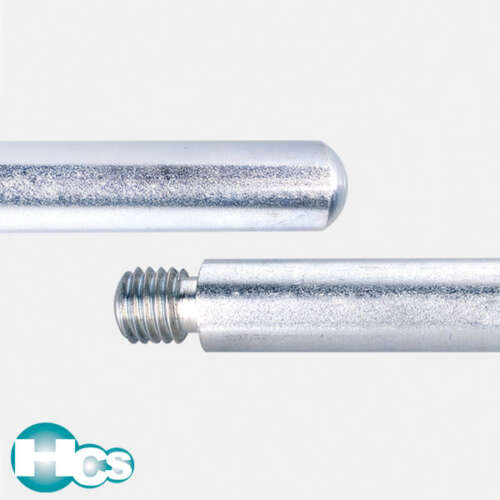 Manufactured either from galvanized steel or stainless steel with a M10 thread.
 -
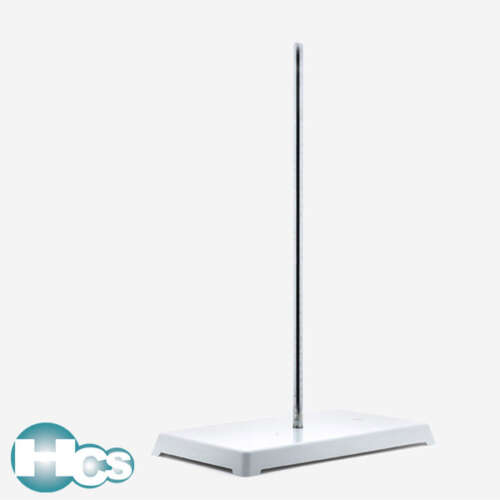 049.04.175 Highly stable rectangular base manufactured from ABS. Base with dimension 175 x 300mm has two rod holding holes. Same rod can be placed either at the center or at the rear of the base. White base color allows a perfect visual observation of color changes during titration applications. Delivered with a screw-in support rod of 600mm height.
 -
 Manufactured from acrylic with ergonomic angled body form with adjustable pipette holding option. Can be used with most pipette brands. Depending on the stand size enables easy holding and handling of 4 or 6 single channel pipettes.
 -
 Manufactured from polypropylene for using with most common micropipette brands. This space saving, robust stand can hold up to 6 pipettes comfortably. The round carrousel stand can rotate 360° around the axis enabling easy reach of any pipette.
 -
 Manufactured from polypropylene for using with most common micropipette brands. Offers practical and easy direct access to micropipettes. This space saving, robust stand can hold up to 6 pipettes comfortably.
 -
 Grade 301 is the slowest of the qualitative papers. This grade is used in qualitative analytical techniques to determine and identify materials. It is also extremely efficient in retaining very fine particles. Grade 301 is generally used for biological products, water analysis, soil analysis and fine precipitates such as cold precipitated barium sulfate. Grade 301 is additionally utilized with Buchner funnels and to clarify cloudy suspensions and wine.
 -
Grade 302 is a thick smooth paper, suitable for the removal of fine particles. This paper is made with 100% pure cellulose fibres that have been strengthened to resist the pressure when they are used in filter press systems. There is therefore no contamination danger during transfer steps. This high absorbency grade is twice as thick as Grade 301 with a bigger pore size. The extra thickness gives higher wet strength and loading capacity, enabling more precipitate to be held without clogging the filters and better handling. Grade 302 is also highly suitable for use in Buchner funnels and dye filtration.
-
This grade has a larger pore size than Grade 301, but with a lower filtration speed. Grade 303 also has higher absorption than Grade 301 is it used in general laboratory applications. Grade 303 is also found in agricultural and environmental laboratories for plant growth trials, soil testing and air analysis for monitoring specific contaminants and in the filtration of organic and sulfide precipitates.
-
This grade covers a wide range of laboratory applications and is used for clarifying liquids and for rapid filtration of coarser precipitates such as lead sulfate, lead chromate, calcium oxalate, calcium carbonate, aluminum phosphate, barium carbonate and beryllium hydroxide. Grade 304 can be found in soil analysis, seed testing and in air pollution to collect dust-laden air and is also commonly used in the food industry to separate foodstuffs from the associated liquid of extracting liquid.
-
This grade is used for the filtration of coarse particles and gelatinous precipitates such as ferric aluminum and magnesium hydroxides. Grade 305 is used in air monitoring and gas filtration when high flow rate is needed. This grade is also found in routine cleanup analysis of insoluble liquids such as biological fluids and organic elements.
-
 Manufactured from polypropylene. The standardized screw caps for PP bottles DIN 168. Refer here for bottles
 -
 Standardized screw caps for PE bottles DIN 168. Screw cap is made of HDPE.
 -
 Manufactured from high-quality polystyrene which resists to most acids, bases and many commonly used solvents. Guarantees temperature resistance between -10°C to +70°C. Sterile spatulas are manufactured as single use. They eliminate the cost of separate sterile bags or containers in sample collection. Perfect shape and size enable efficient sampling of various powder, granulate and paste form samples. Sharp blade penetrates directly into paper or plastic bags for optimum and quick sampling process. Easy to grip and long handle increases the distance between the hand and the sample to reduce cross-contamination risks. Approximate volume values are printed on scoop handles. Sterile spatulas are featured with a transparent lid which protects the samples from dust, moisture, and other effects. The transparent lid should be closed immediately after the sampling to secure a sterile and contamination-free sample. The lid is featured with a frosted write on area for practical use.
 -
 Manufactured from PTFE. The stirrer blade will fit all standard button-tip stirring shafts. "Long groove" keyhole (Ø9mm) provides easy insertion into flask neck and proper position for stirring action. Can be used continuously at temperature up to 250°C and, 300°C for short intervals. Suitable for foodstuff.
 -
 Stirring rods are available in two versions. Pure PTFE solid rod with tapered end and pure PTFE with mild steel core. The version with steel core can be bent into a permanent shape. Inert and will not scratch, use up to 280°C
 -
 Manufactured from polypropylene, The blades are chemical resistant and are fixed to a steel rod covered with PP with a diameter of 8 x 350mm long.
 -
 Produced from PVC, the stirring rods are rigid, light yet unbreakable. product is an ideal replacement for glass rods.
 -
 Plug is precision ground and hand-lapped with corresponding numbers one the barrel and plug; 1:10 taper. With constant pressure retention spring and clip.
 -
 With Solid Plug. With constant pressure retention spring and clip.
 -
 With polished barrels.
 -
 Stopcock with three stems sealed 90°apart. Teflon plug has a "T" shape bore to connect any two or all three stems.
 -
Plugs and barrels are ground to be interchangeable, with 1:10 taper.
-
 With 1:5 Teflon plug and a threaded pressure nut. Stopcock barrels are polished to prevent PTFE plug from scratch.
 -
 A 1:5 taper Teflon stopcock with three sidearms sealed 120° apart. Plug has a bore to allow connection of any two arms at once.
 -
 Kartell 1759 Dimension 90x165 mm Manufactured from PP and HDPE. The stopcocks is ideal for liquids and gases under low pressure (operating pressure 0.5bar) or low vacuum. The HDPE body interfaces with PP tap giving a smooth turning action requiring no lubricants .
 -
 Manufactured from Polypropylene. The standard staper 1:10 ensures perfect sealing action. Hose adapters Ø 8 - length 20mm. NS cone 29/32 lower Ø26.2mm
 -
 Measurements: Bottom diameter x top diameter x height. Manufactured from no-porous additive free, best quality natural cork according to DIN 12871 standard dimensions. Offers multi advantages with their light weight yet robust construction. Can be easily drilled.
 -
 Manufactured from polyethylene for perfect tight sealing of special test tubes. Large size flanges on the stopper perfectly touch to the walls of the tubes and offer the best leak-proof sealing. Grooved, conical body shape guarantees perfect closure. Color-coded stoppers enable fast, easy and practical identification of bottle content.
 -
 All sizes are with joints.
 -
 Manufactured from heat resistant, durable borosilicate glass according to DIN 12252 standard. Hexagonal flat head prevents the stopper from rolling on the bench and avoids the breakage risk. A pointed, round formed “drip-tip” stopper lower end guarantees return of the adhered liquid back to the flasks.
 -
 Manufactured from heat resistant, durable borosilicate glass according to DIN 12252 standard. Hexagonal flat head prevents the stopper from rolling on the bench and avoids the breakage risk. A pointed, round formed “drip-tip” stopper lower end guarantees return of the adhered liquid back to the flasks.
 -
 All sizes are with joints. Heavy wall design.
 -
 All sizes are with joints.
 -
 Manufactured from polypropylene for perfect tight sealing for all NS joints. Hexagonal flat head prevents the stopper from rolling on the bench and avoids the breakage risk. The hallow form of the stopper head collects the adhered liquid and prevents the possible damage risk of the laboratory benches.
We have retired the old website, please let us know if you encounter any issues here


Tel: +65 6777 7077
Email: marketing@hcs-lab.com
Tel: +65 6777 7077
Email: marketing@hcs-lab.com


Get in touch with us today for any inquiries, assistance, or collaborations. We’re here to help!


Copyright ©2026 | HCS Scientific & Chemical All Rights Reserved
